




By clicking the “I Accept” button, or by accessing, participating, or submitting any information, or using the Jabil Global Intelligence Portal or any of its associated software, you warrant that you are duly authorized to accept the Global Intelligence Portal Terms and Conditions on behalf of your Company, intending to be legally bound hereby, and your company shall be bound by the terms and provisions of the Global Intelligence Portal Terms and Conditions, accessible under the following link Portal T&Cs.
Jabil's Global Category Intelligence Archive
Global Category Intelligence
Q4 2022
Jabil's Global Category Intelligence Archive
Global Category Intelligence
Q4 2022
Guided Buying
Delivering value through Guided Buying
Online self-service has become part of everyday life. During the pandemic, people became increasingly reliant on the ability to get what they need to be delivered to their doorsteps quickly. Companies supporting the consumer market made ordering online simple, allowing efficient product comparison whilst delivering a seamless user experience. However, that experience was rarely replicated within the business community.
In many companies, initiatives exist to simplify processes related to onboarding an employee or to booking travel; however, procurement organizations often fail in utilizing technology to drive bureaucratic processes across all levels of purchases.
Procurement systems remain complex and business consumers are often unaware of the variety of policies and guidelines governing their purchases. This often leads to process inefficiency with users often relying on a credit card, their source, or purchasing at a higher cost through their preferred contacts. This behavior may even result in losses on volume-based incentive programs due to a lack of spending visibility.
It can also lead to a cyclical process of procurement implementing strict governance and imposing more complex processes to drive down overheads. The exercise is time-consuming, and burdensome and redirects employee efforts onto meeting internal guidelines, rather than driving continuous improvement. For those reasons, many procurement leaders are turning to guided buying.
What is Guided Buying?
Guided Buying is a principle that aims to simplify the purchasing process by directing users to the proper procurement channels. The technology is focused on user experience and must be intuitive, persona-based, efficient, smart, and empowering, to policy and compliance. Technology can route a business consumer into preferred, category-specific buying channels such as a catalog or an intake form, all of which enable centrally led governance and procurement controls without the requirement to be involved in every purchase.
Procurement creates a business consumer experiential learning environment that encourages the use of the technology and therefore increases spending under management and compliance. The procurement function retains control and empowers the business consumer to get what they need faster. Implementing market-leading guided buying systems is typically only the starting point for procurement teams as they establish controls and drive managed catalog spending. Most companies are confronted with the need to formulate agile strategies in dealing with new strategic partner selection, communicating catalog offerings, and providing sourcing direction to the end business consumer.
How to manage the challenges of Guided Buying in an ever-changing Procurement landscape.
Throughout the supply chain, companies purchase different categories of goods and services. It can consist of a variety of products purchased at different volumes. Procurement organizations are challenged to find ways to drive cost leadership on goods and services, ranging from one-off customized to high-volume commercial off-the-shelf products.
There is no “one size fits all” approach between categories or supplier partners. Contracts require re-negotiation and suppliers may try and increase pricing in those contracts if a company is not monitoring performance over time. So how does Procurement manage the relentless challenges of guided buying?
Companies must start by identifying their core principles around which all procurement decisions can be anchored. Like writing a mission or a vision, the team needs to understand where their journey is headed.
Once core principles are documented and clearly defined, the organization should look to institutionalize an iterative and agile process to analyze procurement data and use technology to influence business consumer buying behavior. Small adjustments are continuously required to people, process, and technology utilization throughout the Procurement process to meet the defined core principles.
Procurement organizations can indoctrinate this simple yet effective 4-step process throughout their daily routine. As the process is executed, the goal is to create a division of tasks into short phases of work and frequent reassessment and adaptation of plans. Over time, this delivers incremental improvements to reaching the core principles, which may be to deliver cost leadership, cost reduction, compliance and digital in this iterative journey. Each rotation of these steps results in a continuous improvement with your business spend management actions.
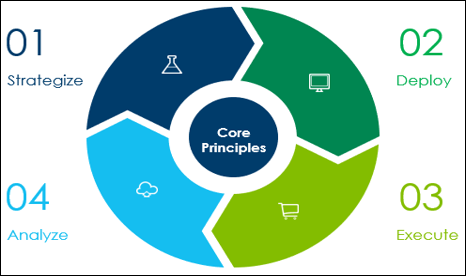
Strategize
It’s essential for procurement organizations must step back and formulate a strategy for delivering on the core principles. At the beginning of that process, it is important to remember that “one size doesn’t fit all”. What may work for office supplies may not work for professional services. The procurement team must analyze individual categories for purchasing trends.
They should ask “does my category have repeat purchases and is a good catalog candidate or are my requirements unique with every transaction? If the spend shows repeat purchases, the category team may either negotiate with a new supplier partner or expand an existing catalog as products change over time.
Catalogs have many benefits and provide:
- Visibility to your preferred partners
- Optionality and partner competition through product comparisons
- Consistency in data enabling procurement to evaluate spend patterns
If the category has unique requirements with every transaction, the category manager may consider sourcing intake forms. Utilize intake forms to gather critical information when the purchases are not pre-defined enabling a reduction in manual communication between procurement and business consumer by providing up-front information required to take sourcing action.
And remember the goal of guided buying is to simplify the purchasing process and direct users down the proper procurement channels. When managing a global organization this can be a challenge. Communication is key and your approach may need to change by country or over time. Do not be afraid to adjust change management, communication, or technology to enhance the user experience. In all scenarios, small adjustments matter to drive effective and efficient business processes.
Deploy
In this step, procurement determines how to deliver the negotiated pricing within an organization. Let’s focus on the identification of repeat purchases that require a new set of catalogs to deploy. There are different options provided with each having its pros and cons.
Punch-Out Catalogs
- Business consumers buy directly from vendor websites.
- Requires business consumers to know which vendor website to visit for the product.
- Control for price accuracy and content is with the supplier.
- Shopping interface is controlled by the supplier partner.
- Minimal set up effort – ownership on the supplier.
- Drives high quality data for analysis.
- Requires partnerships with suppliers with an e-commerce website.
- Difficult to compare prices.
Punchout catalogs are enabled in P2P systems to provide a consumer-like shopping experience to business users and are dynamically managed by supplier partners. Supplier partners maintain all levels of detail and understand that detailed descriptions, part numbers, and images draw attention to their product. Users start in a company’s procurement system and “punch out” to a supplier managed website, which can either be a full SKU list or be limited to specific pre-approved parts.
This should align with the category strategy and empower the business to get what they need when they need it. The shopping experience mimics going directly to a supplier’s website making it more comfortable to the business. The user experience is vital to the success of a procurement strategy. Business consumers need to know which supplier punch out to visit individually, which can be a barrier to price comparisons.
If a consumer is unaware of the existence of a punch-out catalog, maverick spending may occur and higher change management is required. Because this is a pre-approved supplier, procurement does not need to be involved with the approval, making the process more efficient while being compliant with policy.
Hosted Item Catalogs
- Business consumers buy from within a company’s P2P system
- Business consumers do not need to know which supplier to purchase from
- Provides full control to the procurement team
- Provides a consistent interface for item searches within the P2P system
- High effort for internal resources to load items with quality information
- Resource effort drives the data quality as items are maintained by procurement
- Can be loaded for any supplier partner
- Delivers price comparisons, therefore increasing competition and reducing maverick spending.
Hosted item catalogs are loaded into a P2P system at the product level and are maintained by the buyer which can require a significant effort to deliver high-quality data. It is incumbent to ensure items are maintained as prices change or new items are available. The amount of detail in descriptions, images, and manufacturer part numbers enables users to find products. To alleviate this burden, search for a P2P system that provides a feature that allows suppliers to submit hosted item catalogs that require the buyer only to review and approve the items before presented to the user.
This can put the ownership of updating items on the supplier while maintaining control of the approved items. By hosting the items, the business consumer stays within the company’s P2P system, delivering a consistent user interface. This also enables cross-item comparisons.
A single search will bring back items from all hosted item providers. This provides optionality to the consumer, drives suppliers to stay competitive, and reduces maverick spending by providing a seamless single search capability to all approved suppliers from Procurement. Like punch-out purchases, procurement does not need to be involved with the approval, driving process efficiency.
Cross Catalog Searching
- Seamlessly search hosted and punchout in a single search.
- Drive the highest visibility and price competition.
To secure control over items, optionality, price competition, minimal setup, and a high-quality user experience, we recommend using a P2P platform that offers hosted catalog items and has the technical capabilities for cross catalog search. This provides a unified approach whilst utilizing the best of both options.
Cross-searching examines catalogs on behalf of the user and identifies multiple options for one interface. This cross catalog, consumer-style searching provides a consistent experience, creating side-by-side comparisons of returned items. It provides simplicity to the users whilst empowering them to make decisions on which pre-approved supplier to select.
There are multiple channels to deploy the Procurement strategy to the business consumer. The industry must find deployment strategies that work for the consumer. Without the use of catalogs or forms, procurement has not achieved its goals to deliver value to the organization.
Execute
Procurement will evaluate behaviors of the business consumer behavior before requisitions or purchase orders are executed. By this stage, Procurement has set the category strategy and identified pre-approved suppliers and items to present to the business consumer. Procurement may now fall into the “set it and forget it” trap assuming those catalogs are being used.
Companies must invest in resources to monitor how our business consumers are executing their purchases. By doing so, they will be able to ensure that the consumer finds the items they need, identify what products are in demand and if there are any pinch points in the purchasing process. It is not enough to set prices if the user is not consuming the strategy.
Consumer Surveys - Consumer surveys are a simple way to provide customers with the ability to communicate with businesses. Users may identify a process gap that was unknown within organizations. The more customers are empowered, the easier it is for them to fulfill their role whilst the following guidance.
Surveys are, however, unrepresentative of the general customer base. Most consumers reach out to organizations when they are frustrated with products or experiencing difficulties in delivering outcomes. However, whilst their response may not be reflective, it is vital to remain open to feedback and make the small adjustments required.
Systemic Insights - Garnering insights from business consumers cannot solely be reliant on surveys. Technology-driven insights can give procurement real-time information around behavior patterns. By utilizing technology, we can identify consumer trends, including keywords searched, and identify popular sections of the interface. Finding technology with insight and potential to highlight patterns is vital to making proactive and unsolicited improvements for the business consumer.
Content Search Insights – As consumers enter the system, technology can highlight search trends as well as conversion rates. If those items are known to be in a catalog, but not converted, procurement may need to rename or tag an item. For example, in the US, users may search for a band-aide, but in the UK the search would be plaster. If those items are not in a catalog, procurement can run a sourcing event and proactively add a catalog item without consumers making the direct request. This feature is, however, reliant on the consumer searching before free texting a purchase. Therefore, this cannot be your only source of consumer behavior.
Process Insights – This capability allows organizations to review systemic behaviors throughout the system. These insights provide real-time information on where and how users navigate in the system, where are they deviating from the standard process, and which specific buttons are used within the application.
This allows users to see real-time statistics on whether the “Deploy” strategy is making a positive impact on guided buying trends or if more small adjustments are required. If this feature is not available natively in the procurement platform, consider investing in a Digital Adoption Platform.
If the business consumer is not finding catalogs, the value is not delivered. Understanding what and how users are consuming information will enable organizations to proactively deliver on expectations.
Analyze
Our last step in this process is Analyze. Procurement will perform an analysis to identify trend patterns and using the 5 Whys Method, show gaps to the core principles based after transactions have been completed, and then deliver root cause action that will deliver tangible results. Ask yourself:
- Is your deployment strategy guiding consumers down the proper procurement channels based on transactional data? If not, why not?
- Does procurement need to add items to a catalog, establish a new catalog or develop a new form?
- If catalogs are not being used, why? Are prices competitive? Are we choosing quality suppliers?
Analytics
Procurement technology may have inherent analytics modules built into their platforms. This offers companies the benefits of analytics without the burden of data extraction, integration, or manual processes. This reduces the overall cost to manage and enables businesses to spend more time acting on strategy and less time tactically generating reports. Generating reports that will highlight spending on and off catalogs with the ability to codify categories or suppliers that are not effective catalogs creates a realistic view of performance.
By using this strategy within the analytics platform, Procurement can understand the volume of opportunity missed and what identify high performance in their organization.
If the technology does not have native analytics, a tool like Power BI can be used to visualize data to create custom calculations. This would require integration or manual data loading to keep the data up to date with today’s trends.
Whether native or not, analytics reports can be used to highlight catalogs that may be ineffective. Imagine an IT category manager with catalogs in place for laptops. Filtering by commodity and/or supplier can identify where gaps in the process may exist. The strategy set may be to have 100% on the catalog. After reviewing the data, organizations may find the catalog is not being used. They may find a new site missing a punch-out catalog or a site deviating from the policy.
As described earlier, punch-out and hosted catalogs provide a high level of data quality. As business consumers purchase against catalogs, the platform captures pricing information, including supplier or manufacturing part numbers.
Utilizing the supplier or manufacturing part numbers allows procurement to make a comparison in price trends over time. Procurement platforms may inherently have this built into reporting or utilization of analytics may be required. Procurement can fall into a “set it and forget it trap” when strategic suppliers and catalogs are enabled.
The strategy is set, the catalog is deployed, execution is effective, and analysis shows a high level of catalog use. But what happens if an incumbent supplier increases prices slowly over time in the punch-out catalog? This is a fear of procurement when providing a higher level of control to the partner. Do your procurement technology or analytics reports highlight price competitiveness or time trends for procurement to take prompt action?
Analytics and pricing history insights must become part of procurement’s daily DNA. It is important to avoid the set it and forget it trap. Catalogs that were once competitive can become lagging if not monitored. Catalogs you believe should have high use may not.
Understanding which sites, business units, suppliers, or categories are not achieving the strategy outcomes can only be seen with visual dashboards whether native to the procurement technology or outside in tools like Power BI. Arming your team with data to analyze gaps is critical to your incremental performance.
Return to step 1
Begin the cycle again by taking what was learned from the Execute and Analyze stages and “re-strategize.” Small adjustments must be continuously made to make a tangible long-term impact.
- If procurement identified new suppliers to get more spending under management, source it.
- If procurement identified new parts with existing partners under management, expand it.
In both cases, procurement would move through Deploy, Execute and Analyze to support the business to evolve. If the organization has the items under contract or catalog, the current deployment process may have been ineffective when it comes to business consumer activity.
The focus would shift onto strategies to “communicate or control” the spending and deploy, execute, and analyze from a different perspective. Staff must communicate preferred suppliers, commercial terms, or catalogs in a digestible way. If organizations are going to ensure that business consumers are following the desired direction, staff must take ownership of the narrative.
- Announcements – simple yet effective means to communicate
- Category placemats on the home page of a P2P application, policy pages
- Guided Buying Automation – efficiency is driven down to the point of need
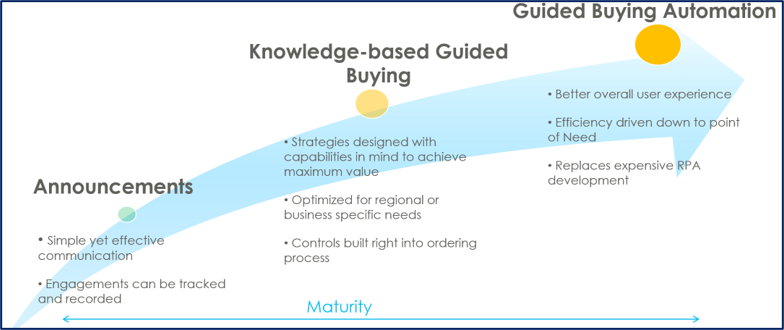
This progressive journey matures over time. Do not expect to start day one with fully automated guided buying. Start simple with effective communication with a vision to fully guided buying automation.
Delivering the procurement strategy starts with simple communication using persona-based announcements. Your procurement technology should enable announcements to be centrally controlled and launched to the business consumers. As strategic partners change, it can be a challenge to ensure the business changes with those expectations.
If your procurement technology announcements are effective, the use of a digital adoption platform may be required. These communications can be targeted as broad or as specific, as necessary. These announcements can also be interactive with links to further information that may exist outside the procurement platform.
This begins to enable a one-stop shop for users to get the information they need when they need it. If utilizing a Digital Adoption Platform, companies can track who views these announcements and follow the information trail provided. Finally, they need to be persona based. Catalogs for engineering services are not important to IT managers.
Targeting a specific audience to ensure the announcement is relevant ensures users do not get overwhelmed with announcements that are not relevant to their work.
Category Placemats & Policy Pages
Where announcements are simple and effective, businesses cannot send information to users for all categories daily. Announcements are good for point-in-time changes or infrequent reminders. As procurement organizations grow, so too will the strategy.
It will become increasingly more difficult to communicate those strategies to the business. As you progress along the maturity curve, organizations will move to provide knowledge-based guided buying.
This can include collaboration with your category teams or buyers providing insights not only into new content that can be created but also allowing purchasing professionals to take into consideration the end process while developing strategy. Procurement technology offers the ability to create Category Placements that provide a summarized view of Strategic Suppliers, commercial benefits, and the ability for a business consumer to free text if required.
This step in the maturity curve begins to provide a foundation for an organization to move towards guided buying automation.
Finally, at the furthest end of this maturity curve, procurement can elevate the end-user experience when guiding them to the right source by enabling technology that delivers in-context automation and user interaction at the point of need.
As you move toward automation, the system becomes less reliant on user knowledge to get them to the right buying channel. The system tells them when and where to go. This capability can be delivered using a digital adoption platform, creating process efficiency without complicated coding that can be time-consuming and expensive. Here are a few examples:
IT wants CAD software purchased by IT only. The business consumer sees the supplier in the system and attempts to enter a request. Guided buying automation recognizes this behavior and at the point of entry, notifies the user that they must go to Service Now to request the software. This message is persona-based, which would allow an IT user to continue, but a non-IT user will be blocked.
Procurement wants laptops purchased only from a catalog or a strategic supplier. As the business consumer selects the laptop commodity, a customized message appears notifying them to use the catalog or an off-catalog intake form. The intake form would require the user to answer key questions about why they cannot use the catalog and provide specifications for the required laptop for procurement to source quickly. This may identify a need to add a new laptop to the standard catalog offering if the form is used frequently.
These are powerful examples of how guided buying automation can help the business consumer receive the procurement strategy at the point of execution. To push the limits, both procurement technology and digital adoption platforms can become more interactive. A chatbot or action bot can be used to ask the user questions that can lead them to a list of preferred supplier options for their need.
Digital Adoption Platforms can move procurement up the maturity curve to enable the core objectives of the organization to be met driving cost reductions, cost leadership, compliance, and digital execution.
Guided Buying is Achievable
- Organizations must be focused on Guided Buying
- The process must iterate around Core Principles
- Procurement must have a documented Strategy or progression is difficult
- There is no “one size fits all” approach to Deploying the Strategy
- Each consumer Executes differently
- Analysis and data lead the way to improvement
- Digital Adoption technology can deliver communication, change management, and controls
Remaining strategically agile in the evolving environment can be a challenge for procurement organizations. Guided buying is achievable, but only with the right mindset change and the right people, process, and technology to deliver on the procurement strategy.

Back to Top