




By clicking the “I Accept” button, or by accessing, participating, or submitting any information, or using the Jabil Global Intelligence Portal or any of its associated software, you warrant that you are duly authorized to accept the Global Intelligence Portal Terms and Conditions on behalf of your Company, intending to be legally bound hereby, and your company shall be bound by the terms and provisions of the Global Intelligence Portal Terms and Conditions, accessible under the following link Portal T&Cs.
Global Category Intelligence
Q2 2025
Global Category Intelligence
Q2 2025
Piracy Threats in Singapore Challenge Electronics Supply Chains
Global Procurement Spotlight
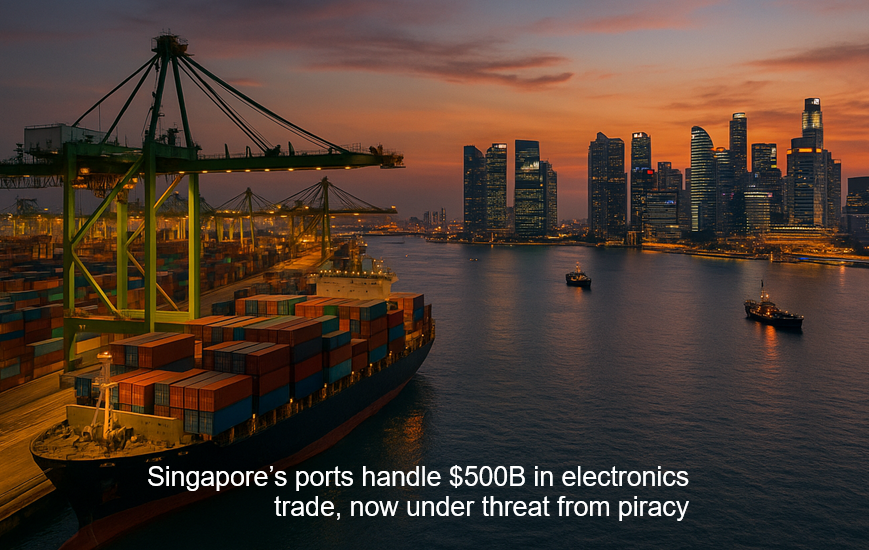 Welcome to the launch of our “Global Procurement Spotlight” series, kicking off with Singapore, a global electronics hub managing $500B in trade annually.
On April 30, 2025, pirates boarded a bulk carrier in the Singapore Straits, stealing engine spares and escaping, marking the 27th piracy incident this year (ReCAAP ISC, 2025). This incident underscores the persistent threat in the region, which handles 30% of global maritime trade and 50% of Southeast Asia’s electronics shipments, including $50B in IT hardware and MRO supplies for companies like Flex and HP. The Singapore Straits, a 105-km chokepoint, saw 99 incidents in 2024, costing $123M annually, with costs per incident rising 10% to $1.24M in 2025 due to increased fuel and insurance premiums (ReCAAP ISC, 2025).
For indirect procurement teams, this piracy surge impacts logistics ($40M/month in delays), insurance ($30M in premium hikes), and supplier risks ($20M in delays for firms like Dell), threatening $2B in Q3 losses if unaddressed.
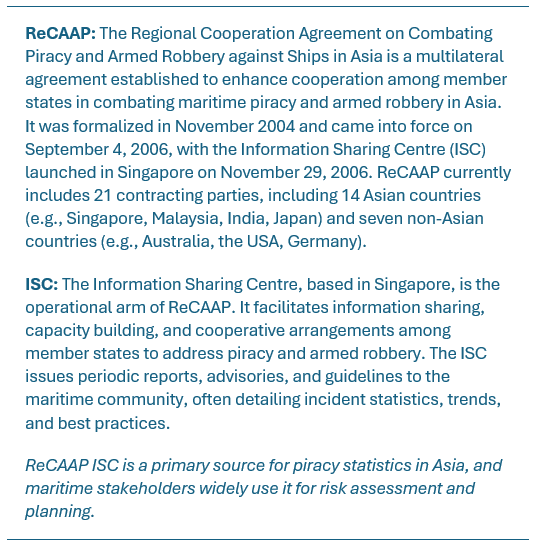 Singapore’s electronics sector is critical, producing 5% of global semiconductors ($50B/year) and handling $500B in trade, making it a prime target for piracy. The April 30 incident involved a bulk carrier carrying $10M in engine spares for MRO, highlighting vulnerabilities in non-containerized cargo. Piracy also drives $20M in emissions costs from rerouting, conflicting with Singapore’s sustainability goals (e.g., net-zero by 2050). Compared to Malaysia, a neighboring electronics hub with $300B in trade, Singapore faces higher risks—Malaysia reported 15 incidents in 2024, with costs per incident at $800,000, 35% lower than Singapore’s due to less dense traffic (ReCAAP ISC, 2025). However, Malaysia’s weaker enforcement (e.g., fewer KOPASKA patrols) increases delays by 20% ($15M/month), affecting firms like Intel. Singapore’s strategic location amplifies its exposure, but its robust port infrastructure (e.g., 90% on-time delivery at PSA Singapore) offers procurement teams opportunities to mitigate risks, as we’ll explore.
This article builds on our recent India dairy coverage (April 30) and shifts focus to Southeast Asia’s supply chain challenges.
Procurement Impacts, Regional Comparison, and Case Study
Impacts on Indirect Procurement
The piracy surge in the Singapore Straits creates significant challenges for indirect procurement teams.
-
Logistics costs have risen, with companies like Maersk facing $40M/month in delays due to rerouting 200 vessels, adding $1,000/container for 5,000 containers/month. Insurance premiums have increased by 10% ($30M for $300M in cargo) as insurers like Allianz adjust for higher risks, impacting $50B in electronics and MRO supplies.
-
Supplier risks are also mounting—Dell faces $20M in delays for $10B in IT hardware, while Flex reports $15M in MRO supply disruptions.
-
Piracy’s environmental impact adds $20M in emissions costs from rerouting, conflicting with Singapore’s ESG goals (e.g., 15% emissions reduction by 2030).
Procurement teams must address these costs while ensuring supply continuity for Singapore’s $500B electronics trade.
Comparing to Malaysia
With $300B in electronics trade, Malaysia faces similar piracy threats but with different dynamics. While Singapore reported 27 incidents in 2025 (YTD), Malaysia has seen only 4, reflecting lower traffic density in the Malacca Strait (20% of Singapore’s volume). However, Malaysia’s weaker enforcement—lacking Singapore’s KOPASKA patrols—results in 20% longer delays ($15M/month for 100 vessels), impacting firms like Intel ($10M in delays for $5B in chips). Malaysia’s piracy costs per incident are lower ($800,000 vs. $1.24M in Singapore), but its less developed port infrastructure (e.g., 80% on-time delivery at Port Klang) increases logistics risks by 10% ($5M/month). Singapore’s robust infrastructure offers procurement teams more reliability, but its higher exposure requires stronger risk mitigation, as we’ll see in the case study.
Case Study: Flex’s Response in Singapore
Flex, a Singapore-based electronics manufacturer managing $10B in IT hardware, faced $15M in MRO supply delays due to piracy in 2025. The procurement team implemented AIS tracking for 90% of shipments, reducing theft by 30% and saving $5M. They renegotiated insurance with Allianz, capping premiums at 5% ($3M savings on $60M in cargo), and partnered with HMM to reroute 20% of shipments via the Sunda Strait, saving $2M at $500/container. These actions cut emissions by 10% (supporting ESG goals) and ensured 95% on-time delivery, demonstrating how procurement can mitigate piracy risks. In Malaysia, Intel adopted similar AIS tracking but faced $1M in additional logistics costs due to Port Klang’s inefficiencies, highlighting Singapore’s infrastructure advantage.
Strategies, Regional Insights, and Looking Ahead
Strategies for Indirect Procurement Teams
Indirect procurement teams can mitigate piracy risks in Singapore with targeted strategies. First, implement AIS tracking for 90% of shipments, reducing theft by 30% and saving $5M, as Flex did. Second, renegotiate insurance contracts to cap premiums at 5%, saving $3M on $60M in cargo. Third, reroute 20% of shipments via the Sunda Strait, saving $2M at $500/container while cutting emissions by 10% to meet ESG goals. Fourth, stockpile 4 weeks of IT hardware ($500M) and hedge $300M in freight futures, preventing $2B in Q3 losses. Finally, invest $10M in AI risk forecasting (e.g., IBM tools) to predict piracy hotspots, saving $200M in potential disruptions while aligning with Singapore’s digital transformation goals.
 Regional Insights: Lessons from Malaysia
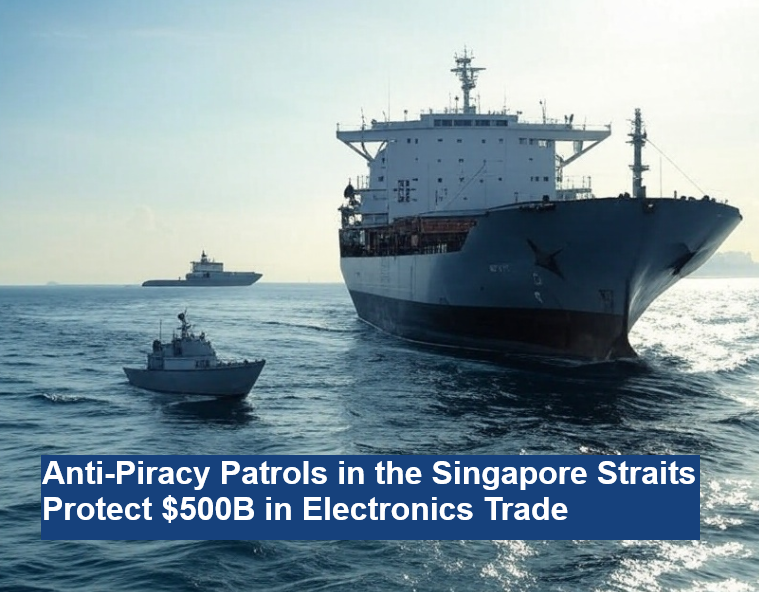
Malaysia’s piracy challenges offer lessons for Singapore-based procurement teams. While Singapore’s higher incident rate (27 vs. 4 in 2025 YTD) drives costs, its robust infrastructure (90% on-time delivery) provides a buffer Malaysia lacks (80% at Port Klang). Malaysia’s weaker enforcement increases delays ($15M/month), suggesting Singapore teams should advocate for enhanced patrols (e.g., KOPASKA expansion) to reduce incidents by 20%, saving $10M/month. Conversely, Singapore’s higher exposure requires proactive measures like AIS tracking, which Malaysia also uses but with less impact due to port inefficiencies ($1M added costs). Both regions highlight the need for regional cooperation—joint patrols could save $20M annually across the Straits, benefiting firms like Intel and Flex.
Key Takeaways
The piracy surge in Singapore demands proactive strategies to protect $500B in electronics trade for indirect procurement teams. Here are the key actions to take:
-
Implement AIS Tracking: Monitor 90% of shipments, reducing theft by 30% and saving $5M.
-
Renegotiate Insurance: Cap premiums at 5%, saving $3M on $60M in cargo.
-
Reroute Shipments: Shift 20% via Sunda Strait, saving $2M at $500/container, with ESG benefits.
-
Stockpile and Hedge: Stockpile IT hardware ($500M) and hedge freight ($300M), saving $2B.
-
Invest in AI Forecasting: Spend $10M on AI tools to predict risks, saving $200M.
-
Learn from Malaysia: Advocate for joint patrols to save $20M annually across the Straits.
These steps will help you stay resilient—check back tomorrow for more actionable insights!
Looking Ahead
Piracy in the Singapore Straits remains a persistent threat, with incidents projected to rise 10% in 2025, potentially costing $150M annually (ReCAAP ISC, 2025). As Singapore’s $500B electronics trade grows, procurement teams must prioritize resilience. Next week, our “Global Procurement Spotlight” series continues with Malaysia, exploring $300B in electronics trade challenges. Stay tuned for daily insights on tariffs, ESG pressures, and more.
Make Indirect Impact your daily habit to navigate these challenges!

Back to Top