




By clicking the “I Accept” button, or by accessing, participating, or submitting any information, or using the Jabil Global Intelligence Portal or any of its associated software, you warrant that you are duly authorized to accept the Global Intelligence Portal Terms and Conditions on behalf of your Company, intending to be legally bound hereby, and your company shall be bound by the terms and provisions of the Global Intelligence Portal Terms and Conditions, accessible under the following link Portal T&Cs.
Global Category Intelligence
Q2 2025
Global Category Intelligence
Q2 2025
South Korea Wildfire in Daegu Disrupts Electronics Supply Chains, Challenges Indirect Procurement
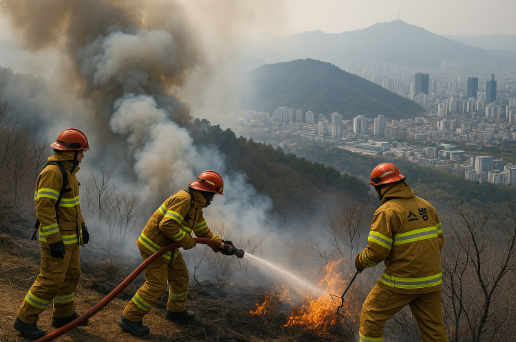 On April 28, 2025, a wildfire near Daegu, South Korea, escalated into a national emergency, evacuating over 1,200 residents and spreading across 151 hectares. The fire was fueled by strong winds up to 15 m/s (Korea Forest Service, 2025).
Daegu, a key electronics hub, produces 5% of global semiconductors ($50B/year), while nearby Busan port handles 20% of South Korea’s $200B trade. The fire threatens factory closures and port bottlenecks, risking $100-200M daily in chip, appliance, and auto parts disruptions.
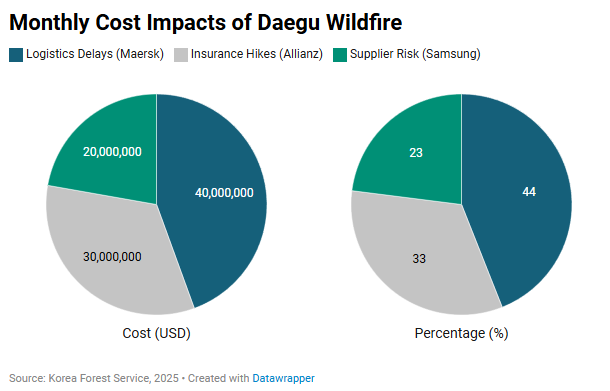
Companies like Samsung, SK Hynix, and Hyundai face immediate impacts, with Maersk reporting a 20% throughput loss at Busan, costing $40M/month (200 vessels delayed). Following a March 2025 wildfire outbreak that caused $1.35B in damages, this event underscores South Korea’s vulnerability to climate-driven disasters, exacerbated by unseasonably high temperatures (4.5°C above average).
For indirect procurement teams, the stakes are high: logistics delays, insurance hikes, and supplier risks threaten $2B in Q3 losses. However, as we'll explore, strategic actions like rerouting and stockpiling can mitigate impacts. This article builds on our recent EU AI focus (April 28) and prepares you for the “Global Procurement Spotlight” series launching May 1 with Singapore.
Procurement Challenges and Case Study
 Logistics and Insurance Challenges
The wildfire’s impact on Busan port creates significant logistics challenges for indirect procurement. Maersk faces $40M/month in costs due to a 20% throughput loss, delaying 5,000 containers/month for HMM ($60M impact) and raising TV prices by 5% ($500/unit). DHL’s 1M tonnes/year face $20M in rerouting costs. Insurance costs are also rising—Allianz has implemented 5% premium hikes ($30M) for 200 exporters, affecting $60B in electronics and textiles. Procurement teams must act to renegotiate 3PL contracts and insurance policies to mitigate these costs while ensuring ESG-compliant safety for workers and suppliers.
Case Study: LG Electronics’ Response
LG Electronics, managing 500,000 units of electronics through Busan, faced $50M in delays due to the wildfire. The procurement team rerouted 10% of shipments to Incheon port, saving $20M by negotiating $500/container rates with HMM and DHL. They also airlifted 5% of critical components via Seoul ($5/kg), preventing $300M in downstream retail losses for partners like Best Buy ($500M Q3 impact avoided). This proactive approach demonstrates how procurement can turn disruptions into opportunities, a strategy we’ll revisit in our Singapore spotlight on May 1.
Strategies and Looking Ahead
Strategies for Indirect Procurement Teams
Procurement teams can mitigate the Daegu wildfire’s impact with targeted strategies. First, optimize logistics by rerouting 10% of electronics (e.g., LG’s 500,000 units) to Incheon, saving $20M at $500/container through 3PL contracts with HMM/DHL. Airlifting 5% of auto parts (Hyundai, $20M) via Seoul ($5/kg) prevents $300M in delays. Second, manage insurance costs by negotiating Allianz policies with 5% premium caps, saving $5M on $1B in cargo. Third, supplier resilience can be strengthened by stockpiling four weeks of chips (SK Hynix, $500M) and hedging $300M in freight futures (DHL), preventing $2B in Q3 losses. Finally, invest $10M in AI risk forecasting to protect Samsung’s $50B chip supply, aligning with ESG safety goals and saving $200M in potential disruptions.
Looking Ahead
The Daegu wildfire highlights the growing threat of climate-driven disruptions, with South Korea facing $1.35B in damages from wildfires this year alone (Wikipedia, 2025). As global electronics and trade routes remain at risk, procurement teams must prioritize resilience. Next week, our “Global Procurement Spotlight” series launches with Singapore, exploring $500B in electronics trade challenges. Stay tuned for daily insights on piracy, tariffs, and more.
Key Takeaways
The Daegu wildfire poses significant challenges, but indirect procurement teams can turn risks into opportunities with these strategies. Here are the key actions to take:
-
Reroute Shipments: Shift 10% of electronics to Incheon, saving $20M ($500/container).
-
Airlift Critical Parts: Airlift 5% of auto parts via Seoul ($5/kg), preventing $300M in delays.
-
Cap Insurance Costs: Negotiate 5% premium caps with Allianz, saving $5M on $1B in cargo.
-
Stockpile and Hedge: Stockpile chips ($500M) and hedge freight ($300M), saving $2B in Q3 losses.
-
Invest in AI: Use AI risk tools ($10M) to protect $50B supply, saving $200M.
These steps will help you stay resilient—check back tomorrow for more actionable insights!
Make Indirect Impact your daily habit to navigate these challenges!

Back to Top