




By clicking the “I Accept” button, or by accessing, participating, or submitting any information, or using the Jabil Global Intelligence Portal or any of its associated software, you warrant that you are duly authorized to accept the Global Intelligence Portal Terms and Conditions on behalf of your Company, intending to be legally bound hereby, and your company shall be bound by the terms and provisions of the Global Intelligence Portal Terms and Conditions, accessible under the following link Portal T&Cs.
Global Category Intelligence
Q2 2025
Global Category Intelligence
Q2 2025
AI-Powered Procurement: How the EU is Leading Innovation Amid Regulatory Challenges
 The European Union (EU) is emerging as a global leader in AI-driven procurement, with 60% of large EU companies adopting AI tools for supply chain management as of 2025 (Gartner). Amid rising geopolitical tensions and environmental pressures, AI is transforming indirect procurement tasks like contract risk analysis, spend analytics, and demand forecasting, saving firms an average of $2 million annually in logistics costs. For example, a German manufacturer recently used AI to predict MRO supply shortages, avoiding $500,000 in downtime costs during a recent port strike. However, the EU’s strict AI regulations, such as the EU AI Act, pose unique challenges, requiring procurement teams to balance innovation with compliance. As we gear up for our "Global Procurement Spotlight" series launching May 1 with Singapore, this article explores how EU procurement leaders leverage AI to drive efficiency in categories like IT hardware and professional services while navigating regulatory hurdles.
Regulatory Challenges and Case Study
Navigating the EU AI Act
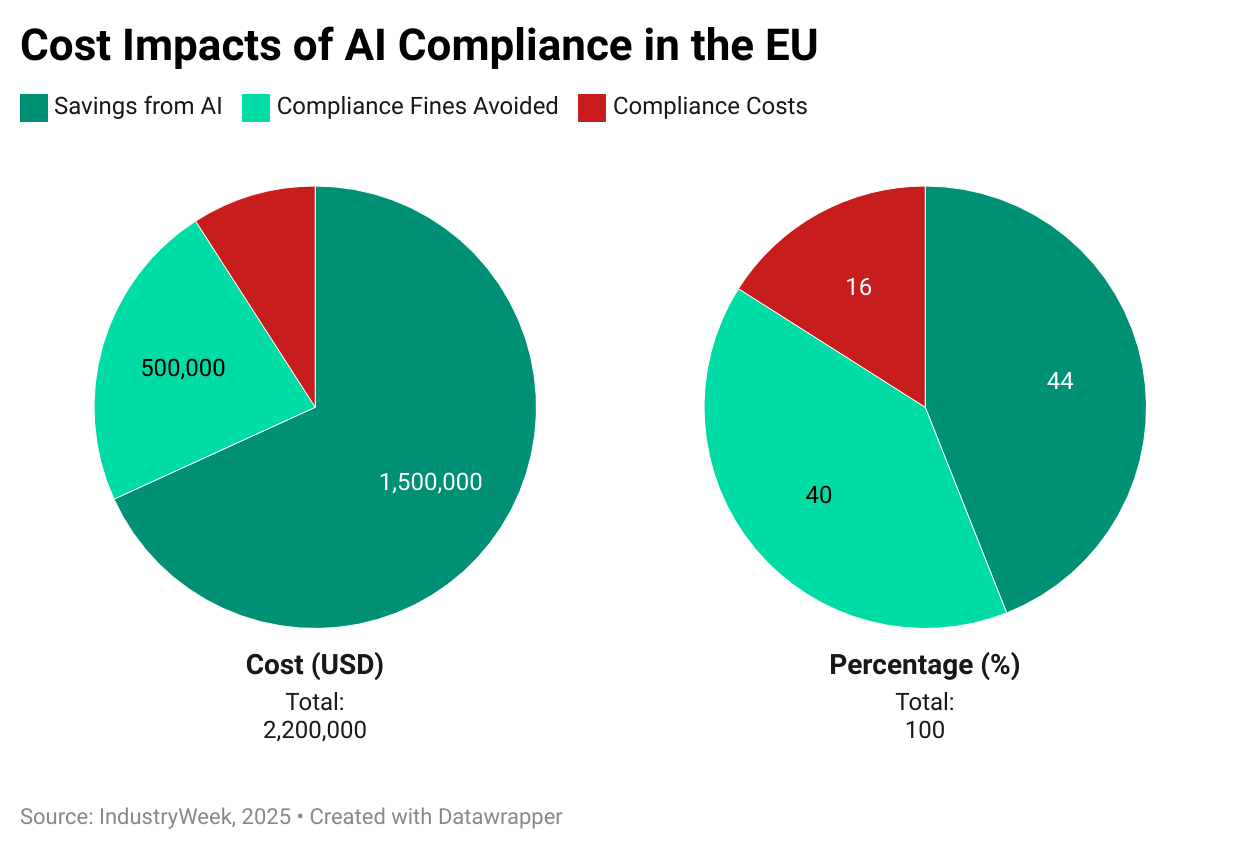 The EU AI Act, fully implemented in 2024, categorizes AI applications by risk, imposing strict transparency and data privacy requirements on high-risk systems like procurement AI (e.g., contract risk analysis). Non-compliance fines can reach €35 million or 7% of global revenue, pushing 25% of EU firms to limit AI use due to compliance concerns. For indirect procurement, this means ensuring AI tools handling IT hardware sourcing or professional services contracts meet ethical standards, adding $200,000 in compliance costs per firm annually (IndustryWeek, 2025). However, the Act also fosters trust, with 80% of EU procurement leaders citing improved supplier relationships due to transparent AI processes.
Case Study: A Nordic Retailer’s AI Success
A Nordic retailer, sourcing $50 million in IT hardware annually, implemented an AI-driven spend analytics tool in 2024, saving $1.5 million by optimizing supplier contracts. By aligning with the EU AI Act—using explainable AI models and anonymized data—the retailer avoided $500,000 in potential fines while improving on-time delivery by 20%. This success story highlights how EU firms can innovate responsibly, a theme we’ll explore further in our Singapore spotlight.
Strategies and Looking Ahead
Strategies for EU Procurement Teams
EU procurement teams can adopt several strategies to harness AI while navigating regulations. First, invest in explainable AI models to ensure transparency, reducing compliance risks by 30% (KPMG, 2025). Second, upskill teams to bridge AI skills gaps—50% of EU firms plan to train staff on AI ethics by 2026 (GEP, 2025). Third, partner with compliant suppliers, as 70% of EU companies now prioritize vendors with AI governance frameworks (Ivalua, 2025). Fourth, AI can be used for predictive analytics to optimize IT hardware and professional services sourcing, saving $1 million annually for 5,000 contracts. Finally, AI can be integrated with ESG goals—AI can reduce emissions by 15% through optimized sourcing, supporting sustainability mandates.
-
Use Explainable AI: Reduce compliance risks by 30% with transparent models
-
Upskill Teams: Train staff on AI ethics to bridge skills gaps
-
Partner with Compliant Suppliers: Prioritize vendors with AI governance frameworks
-
Leverage Predictive Analytics: Save $1M annually on IT hardware sourcing
-
Integrate with ESG Goals: Cut emissions by 15% through optimized sourcing
Looking Ahead
The EU’s leadership in AI-driven procurement sets a global standard, influencing regions like Singapore, which we’ll explore in our "Global Procurement Spotlight" series starting May 1. As AI adoption grows—projected to power 25% of logistics KPIs by 2028—procurement teams must balance innovation with compliance. Next week, we’ll dive into Singapore’s $500B electronics trade challenges, piracy updates, and more.
Make Indirect Impact your daily habit to stay ahead!

Back to Top