




By clicking the “I Accept” button, or by accessing, participating, or submitting any information, or using the Jabil Global Intelligence Portal or any of its associated software, you warrant that you are duly authorized to accept the Global Intelligence Portal Terms and Conditions on behalf of your Company, intending to be legally bound hereby, and your company shall be bound by the terms and provisions of the Global Intelligence Portal Terms and Conditions, accessible under the following link Portal T&Cs.
Jabil's Global Category Intelligence Archive
Global Category Intelligence
Q3 2023
Jabil's Global Category Intelligence Archive
Global Category Intelligence
Q3 2023
- In today’s fast-paced, global economy, chief procurement officers (CPOs) face numerous challenges. Whether it’s supply chain concerns, constrained talent, resource availability, or orchestrating workarounds due to geopolitical strains, in the end, the goal is finding a way to do more with fewer resources.
- Solutions to these challenges are readily available through the effective leverage of digital technology and toolsets.
- Digital transformation empowers CPOs to drive cost savings, enhance efficiency, improve supplier relationships, manage risks, make strategic decisions, and adapt to dynamic business environments.
- When organizations invest in digital transformation, however, they want assurance of a lasting transformation and not just a short-term bump in productivity – aka the ‘optimization’ trap.
- Yes, they want to know that the digital tools being implemented are going to be successful at launch, but ongoing as well, leading to sustained and continued productivity gains. They want stickiness—the ability of their digital transformation to retain and engage their user set over the long term.
Digital Transformation—The Long Game
- According to recent surveys of procurement executives, 70% report failure in their digital transformations, due in some part to being too focused on incremental improvements and losing sight of broader transformational opportunities.
- True digital transformation aims to revolutionize the entire organization. But for new digital tools to deliver their intended value, user training must be sticky or risk falling prey to the optimization trap (i.e., like the 7 out of 10 surveyed.) Successful training drives all the following:
- adoption and acceptance
- data integrity and reporting accuracy
- improved security and compliance performance
- enhanced communication and change management
- value extraction, reducing maverick spend
- greater efficiency improving the productivity gap.
- Hands-on training, ongoing support, and regular communication all serve to ensure users are properly trained and equipped to leverage the effectiveness of a company’s digital transformation investments.
- Without proper training and support, users begin to resist or struggle to adopt these new tools and processes leading to reduced productivity and lower adoption rates.
- Introducing and sustaining the utilization of technology solutions requires finding the balance between digital optimization’s short-term goals and the longer-term transformation that is the ultimate objective.
Secure Long-Term Adoption through User Focused Engagement
- Attention spans—for all people—have reduced dramatically in the past twenty years.
- Rich visual/aural inputs via handheld devices or enormous streaming signage in our physical surroundings often compete for our engagement at work with what’s right in front of us: a set of tasks to perform. Information is everywhere.
- Studies suggest that the open window for a meaningful connection, engagement, or enriching interaction is a duration of time lasting no longer than 8 seconds.
- Training delivery—how users are engaged—is where many digital transformations begin to fail. For younger, digitally-native employees entering the workforce in recent years, training them to the task is exceptionally challenging.
- The content can be broken up or made more ‘user friendly’—to accommodate the needs for shorter attention duration—but if it is not reinforced or otherwise made sticky, longer-term compliance stats will not be robust.
- The technical go-live may have been a success, but what about the next twelve to eighteen months? Days, where users could be trained once and be successful long-term, are in the past.
- To add to the complexity, we must consider that not all employees learn in the same way, adding to the challenge of engagement and reinforcement. Teams must ask themselves:
- Can users be provided the information they need effectively in the 8 seconds they need it?
- How can information be shared in different creative ways?
- How can this information keep up with the dynamic pace of changing technology interfaces and offerings?
- A technology toolset called a digital adoption platform (or DAP) has the answers.
Digital Adoption Platforms (DAP)
- What is a DAP? Many people who interact with a digital adoption platform simply don’t even know it at the time. They are designed to be seamless. Think of your experiences on websites where you are prompted with helpful information, guiding your next step, or helping your comprehension of a document, policy, or support program. This is a DAP facilitating communication and interaction with the intention to improve your navigation and comprehension.
- DAPs enable central organizations to inform users what they need at the point in time when they need it.
- Gartner predicts that “by 2025, 70% of organizations will use digital adoption platforms across the entire technology stack to overcome still insufficient application user experiences.”
- Let’s explore some key benefits addressed by using Digital Adoption Platforms.
Improved Adoption & Acceptance
- Every day companies are moving people between job roles or hiring new employees. Both require training people on the systems required for them to perform their new job functions.
- DAPs enable central controls to deliver training content directly to users at their time of need, consistently, reinforcing learning and reducing the need for large local training organizations.
- These platforms are not meant to be a full replacement for interactive expert training. But their ability to be configured for the specificity of the task means less time wading through an entire long training video just to find the one step an employee needs help on.
- They are also an excellent system for delivering ongoing communication of changes and new features and have dramatically improved retention and the need for retraining after onboarding.
- How much training content and how fast? For many new employees or people learning a new system, it is critical that the training journey is gated, something for which DAPs are perfect.
- For example, DAP systems enable companies to start off with the basics of a system prior to the full functionality being unlocked.
- This basic training, which is enabled by Walkthroughs, can be a good start for some users as a prerequisite to full instructor-led training or in many cases fully replace the need for a human resource to provide standard role-based training as part of their onboarding process.
Ensuring Data Integrity & Reporting Accuracy
- Within a procurement organization, the goal of training is for users to become versed in the data used throughout processes enabling business decisions downstream or driving compliance to regulation, but also to understand the process for creating a transaction from end to end. At Jabil, we train users in the importance of:
- Understanding how to create a basic transaction.
- Ensuring the category is correct for a Procurement transaction.
- Selecting an accurate general ledger account for a finance posting.
- Verifying data format in a field for integration to a downstream system.
- Coding an invoice to meet local tax law requirements.
- For most companies, many of these critical elements might be buried in training documentation or otherwise provided without proper context. Digital transformations often fail simply because users are not receiving the reinforcements and contextual interfaces that characterize successful adoption.
- Two critical features of DAPs provide just what is needed. These are called Smart Tips and Walkthroughs.
- Smart-Tips can be placed anywhere within an application to provide additional contextual information to aid a user through a process.
- The user simply hovers over a field and is provided immediate feedback. These tips are authored and maintained by the system administrators and are comprised of the most common questions the team often gets asked with answers that align with the specific business process.
- Prior to digital adoption solutions, users asking these questions had to stop what they were doing and search out subject matter experts or enter a help desk ticket to get some guidance.
- Or perhaps, they just entered bad data. The former: is a needless waste of time, while the latter has the potential of being a disaster.
- In many cases, DAPs will recognize when a user is stuck or off-track and intervene immediately by validating entries to ensure correct formatting or completeness occurs while reminding users of their importance.
- Walkthroughs can be created for any process in the system and act as if a trainer was sitting right beside the user guiding them step-by-step.
- They can be used as a simple tutorial for education or a hands-on guide to help users complete their tasks, such as producing detailed purchase requests or correctly processing invoices.
- The walkthroughs can be accessed at any time and are especially helpful for infrequently used or conditional processes.
- No more hunting through outdated training material to get unstuck from a process. And no more waiting for the next training class to be scheduled!
- Together, smart tips and walkthroughs drive consistency and efficiency in training allowing companies to expand the user base without increasing administrative staff. In many cases, better control of upstream inputs tightens up data security and greatly reduces the need for reworked documents later in the process.
- Right-first-time metrics are key objectives for any organization serious about increasing operational efficiency and reducing administrative headcount.
- Core teams are freed to focus on delivering new modules and features or driving system optimization instead of answering helpdesk questions or training new users.
Improved Security & Compliance Performance
- Policies and regulatory requirements are consistently a challenge for new and even long-term employees. Policy violations due to employee ignorance or just not comprehending the applicability of requirements or rule changes should not happen. A well-customized DAP can eliminate these frustrations.
- Regulatory requirements are often subject to change and the pace can be challenging to keep up with. This is a scenario ripe for potential information overload or employee burnout. DAPs enable companies to not only display policies to employees but can prevent transactions from progressing until the employee acknowledges receipt or understanding of a policy.
- Why train all employees on every aspect of policies they may need to know (everything, all at once regardless of application,) when instead, a DAP will present the policy contextually, during a transaction when the user's focus and understanding are heightened? Imagine being able to add additional buttons, notifications, or content validation above and beyond the capabilities of the base system!
Announcements
- While many employee communications programs may have an announcement feature, they are often lost in the UI as a banner or a sidebar and end up being presented to all users.
- DAP announcements are presented front and center, with interactive features for enhancing user engagement and, if required, guiding the user toward specific actions.
- Messages are displayed within the relevant platform at the point when a user is utilizing that function and can be tailored to the users’ roles and interests.
- As an example, a DAP can provide announcements to Finance team members highlighting the company's new invoicing features, while not presenting that same information to Human Resources.
- This directs the right information to the specific audience that needs it, reducing information overload for others.
- Announcements are summarized, delivering just the kernel of what is needed, but can also contain direct links to reference material for users who want to learn more details.
- DAPs deliver timely, interactive, and relevant announcements where and when they're needed.
Value Extraction - Reduce Maverick Spend
- They say, “Old habits are hard to break!” This is especially true when it comes to procurement. Employees get into the habit of using the same supplier partners to get the goods or services they need to execute their objectives.
- As procurement changes strategic partners, communicating and enforcing the change can be challenging. This becomes even more challenging on a global scale.
- Customizing a system to comply with country or industry-specific regulations can be the difference between passing an audit or failing and incurring additional costs to the business.
- Here’s an example: the sourcing team has been working with ABC Co. but negotiates a deal with lower prices, better terms, and a rebate, if expected thresholds are met, with Acme Co. An email communication is sent advising users of the new partner.
- Six months later the business finance leadership has not seen the expected cost reductions nor did enough business go to the new supplier to meet thresholds for the rebate achievement.
- Upon investigation, the sourcing team discovers that only 20 percent of the recent orders have been going to the new provider.
- The CPO has a few questions.
- Did they communicate with the right people in their organization?
- Did those people open the email and actually read the communication?
- Did their users understand why the company changed supplier partners?
- Did the change to the new supplier occur with the end users?
- A DAP will get the answers.
- The diagram below shows an example of a setup warning that a DAP would implement to fulfill redirection immediately after their new contract was signed.
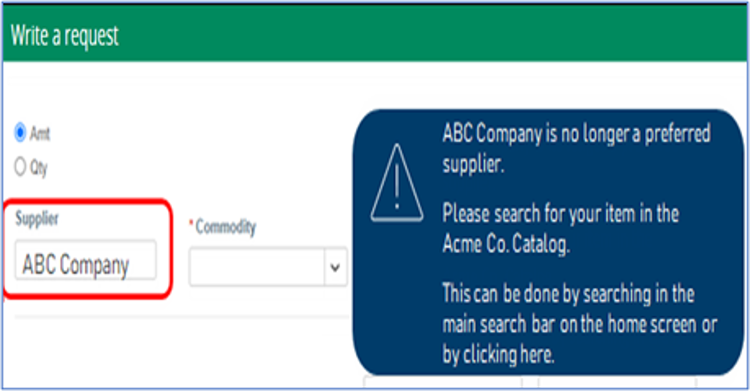
- It not only informs users if they try to make a purchase against the old supplier, but also sends a report to the sourcing team on the exact users still using the old partner.
- Does the data help answer more contextual questions like, was the new deal as good as they thought? Were there key items without availability, or quality was suffering?
- Without a digital adoption solution monitoring the purchases in real-time, this method of immediate enforcement and feedback would have been nearly impossible. Procurement organizations can no longer rely simply on their ability to negotiate a deal.
- They must embrace digital solutions that are designed to see what humans cannot see by themselves, facilitating innovative ways to influence end-user behavior with data-driven decisions.
- Companies and leaders not embracing these data tools may soon be wondering what happened to their margins and why their expected competitive advantage is not being maintained in their markets.
Greater Efficiency Improving Productivity
- Has your team asked:
- Are users reading the documentation developed?
- Are training modules being actively utilized?
- Are there steps in the process that cause confusion for users?
- DAPs monitor specific key processes or identify how users are interacting with the software ensuring information is consumed and that desired process changes are occurring. They are reactive, providing users guidance or even redirection to a more efficient path as identified by the system.
- Insights provided by DAPs help to identify system bugs, bottlenecks, process inefficiencies, incremental training needs, and even potential loopholes being exploited by users to circumvent system controls.
- Admins can place specific tracked events on key actions or process steps that will drive process optimization and create controls for improving compliance and productivity in real time.
- Utilization of these additional insights and process data sets is extremely useful in managing the iterative nature of training materials and system guidance. You cannot have a set-it-and-forget-it mentality.
- Companies that are truly successful with their digital transformations build dedicated resources into the business case to maintain and optimize the system on a continuous basis. This ensures that content is always relevant and accurate.
Digital Adoption Drives Digital Transformation
- Technology alone is not enough to digitally transform an organization or its training culture.
- DAP technologies, however, can help enable more efficient training and knowledge transfer that truly engages employees. By delivering just-in-time training—information for employees when and where they need it—DAPs help organizations fulfill better long-term adoption of critical processes.
- DAPs offer contextualized guidance that is offered directly inside the relevant content or process, reducing technical support costs and accelerating time-to-competency.
- In addition, DAPs can take over repetitive tasks that require little cognitive input, resulting in increased productivity and decreased error rates. DAPs also reduce the time and cost associated with creating and updating training materials.
- By minimizing onboarding friction, simplifying the onboarding experience, and providing efficient training, with real-time access to interactive guides, employees become competent and confident. and much more effective in leveraging an organization’s investments in new technologies.
- With digital transformation secured, CPOs are empowered to make the most accurate and informed decisions, enabling them to act with agility to change business needs and optimize their sourcing strategies.

Back to Top