




By clicking the “I Accept” button, or by accessing, participating, or submitting any information, or using the Jabil Global Intelligence Portal or any of its associated software, you warrant that you are duly authorized to accept the Global Intelligence Portal Terms and Conditions on behalf of your Company, intending to be legally bound hereby, and your company shall be bound by the terms and provisions of the Global Intelligence Portal Terms and Conditions, accessible under the following link Portal T&Cs.
Jabil's Global Commodity Intelligence Archive
Q1 2022
Jabil's Global Commodity Intelligence Archive
Q1 2022
SEMICONDUCTOR COMMODITIES
Analog Power / Signal Chain
Unprecedented volatility continues to impact the overall supply of Analog semiconductors. The COVID-19 pandemic has driven the semiconductor shortage and has severely disrupted the semiconductor supply chain. Unfortunately, we see no near-term signs of recovery.
Foundries are increasing wafer prices, and in turn, IC companies are increasing device pricing. Most suppliers are facing capacity constraints and shortages for substrates, wire bonding, lead frame, materials, and testing capacity, all of which are parts of the supply chain beyond wafer fabs / foundries.
Considering the current market situation, overwhelming market demand is exceeding supply, and manufacturers are no longer able to support any short to lead time orders. We don't foresee any chance to reduce lead times, instead we are seeing lead times continue to increase on many products due to continued demand upsides. Most of the suppliers anticipate that if the strength of demand persists it will ensure a constrained environment through the second half of 2022 and even into 2023. The importance of long-term visibility during this constrained market is essential.
To provide supply continuity, some of the Analog suppliers are encouraging customers to load long-term orders through the end of 2022 and into 2023 to enable better visibility for wafer and capacity planning.
Most of the manufacturers’ CapEx investments won’t increase production volumes until the end of 2022 or later in 2023.
Texas Instruments
TI is experiencing many challenges due to supply-driven issues exacerbating already constrained products. The current demand has reached unprecedented levels constraining much of their portfolio. TI lead times will remain high, and supply is expected to become even more constrained until new capacity comes online in late 2022.
TI can support up to 78 weeks of rolling JIT forecast. It is vital to provide long-term forecast visibility in view of the current constrained market.
- Especially constrained on LBC5, 6, 7, 8, 9 wafer processes. Lead times have stretched to 52 weeks or more. (MPNs: TLCxx, TLVxx. TPSxx, DRVxx ).
- Highly constrained at backend and assembly facilities.
- Major lead-frame shortages.
- Major package constraint: QFN.
Capacity Expansion: Investing in new Capacity in 2021-23
- Backend Assembly: Chengdu – 300,000 Square Feet (Doubles Existing CDAT A/T Capacity) – Ready 2H’21
- Front End Fab:
- Richardson Fab 2 – 300,000 Square Feet (30% larger than RFAB1) – Ready 2H’22
- Will add $5B worth of advanced analog capacity
- Lehi Fab – Acquired from Micron. Advanced Analog and Embedded Processing – Ready 2023
- Richardson Fab 2 – 300,000 Square Feet (30% larger than RFAB1) – Ready 2H’22
- Two new 300mm fabs planned for Sherman, Texas – expected to be production-ready in 2025.
Maxim
Due to unprecedented supply shortages and capacity constraints, it is impossible to foresee any short-term recovery. Maxim will be temporarily moving to a non-cancellable and non-reschedulable order policy (NCNR). Maxim is facing constraints on TQFN/TDFN packages from their assembly partners. Automotive-grade products are heavily constrained. Lead times are typically quoted between 40 and 60 weeks.
Monolithic Power Systems
MPS have increased lead times to more than 50 weeks for both standard and automotive products.
Microchip
Microchip continues to face accelerating demand that outstrips supply. Lead times have extended to 60 weeks for Standard Products and 62 weeks for custom products.
Microchip announced a Preferred Supply Program (PSP) which is designed to deal with the supply constraints impacting the electronics industry.
onsemi (recent rebrand from ON Semiconductor)
onsemi is facing tight supply and backend constraints with demand still outstripping supply. Lead times continue to stretch significantly. They are strongly encouraging customers to extend orders and forecasts deep into the second half of 2022.
Std Analog: AC/DC, DC/DC, Interface (RS232, R485), VR, LDO, Driver, Mixed Signal/Amplifiers and Comparators all quoted at 35 to 50 weeks lead time.
STM
Lead times continue to stretch. STM requires long-term forecast and full backlog coverage.
Power management, AC/DC, DC/AC, Mixed Signal Amplifier & Comparator, Std Analog VR, LDO, Drive all quoted at 28 to 44 weeks lead time. All automotive-grade devices now reflect a 52-week lead time.
Renesas
Renesas is offering a Demand Secure Program (DSP) for 2022 to select customers. For those customers not covered and who are served through distributors, Renesas has encouraged them to load orders to cover demand until the end of 2022 to provide better visibility for wafer and capacity planning. All POs will be NCNR.
Backend Assembly & Test constraints in Malaysia due to resource limitations caused by local Covid regulations.
Lead time: 52 weeks.
Diodes
Lead times are stretching due to tight capacity in both front-end and back-end production.
Lead time: 40 to 60 weeks.
ADI
ADI will not allow CRD push outs or quantity decreases. Imposing a 90-day cancellation window.
Lead time: 50 to 90 weeks.
Lead frame
A surge in demand is impacting lead times, causing lead frame shortages from most manufacturers. Lead frame supply is extremely constrained, and most manufacturers are allocating supply. Lead times continue to extend to 90 weeks, this has a significant impact on low volume high mix products.
Test & Assembly
Due to the COVID impact on labor, both Assembly and Test processes are extremely constrained, and lead times continue to stretch.
- Today’s unprecedented demand for semiconductors is driven by accelerating digital transformation. Wireless/5G, IoT, and automotive are the most important applications driving increased demand over the next year.
- Foundries will exhibit another strong year in 2021 driven by increasing demand for 5G phones, automotive and high-performance computing. TSMC and Samsung will continue to drive a very strong leading-edge foundry market. TSMC expanded capital expenditure from $17B in 2020 to $28B in 2021.
- The industrial application segment along with most other demand segments are estimated to continue to grow for the foreseeable future.
- The global automotive industry is anticipating robust growth well into 2022. Some automotive OEMs have had to shut down production due to the severe shortfall of chips and wafer. Future investment in expanded foundry capacity will therefore be critical so that the automotive industry can avoid such supply chain upheavals in the future.
- Maxim Integrated-Analog Devices merger obtained regulatory clearance from China and the transaction closed in August 2021.
In 2021, the global semiconductor market underwent drastic changes. The upstream supply chain including wafer fabs and packaging and testing facilities have pushed significant price increases to semiconductor suppliers in order to ensure stable supply to meet customer demand – this subsequently impacted component pricing. We foresee this continuing through 2022. Suppliers have strong backlogs, and many are quoting book to bill ratios of more than 1.5:1.
- Analog Devices: Another round of price increases on some of their products from the new combined ADI and Maxim portfolio. These price increases apply to both Direct and Distribution orders.
- For Direct orders – They will start applying these new increases on shipments on or after January 1, 2022.
- For Distribution orders - They will start applying these new increases on shipments on or after December 5, 2021.
- Renesas: Increases by 10 to 20% for the former Intersil legacy products across all customers.
- STM: Price increases of 10~15% especially in the renewal of 2022 contract price with OEMs.
- onsemi – Price increases for Q1’22 due to supply constraints, increased costs and defocus on legacy components.
- TI – Price increase of 10~15%. We saw many price increases in the November timeframe for those end customers finalizing price agreements for 2022.
- MPS – Price increases effective from February 2022 onwards.
- Microchip – Price increasing between 10 and 15%.
- Silicon Lab - Increased pricing on all product lines, including existing backlog, started November 28, 2021.
- Future price developments are directly linked to each supplier’s capacity status which requires continued monitoring.
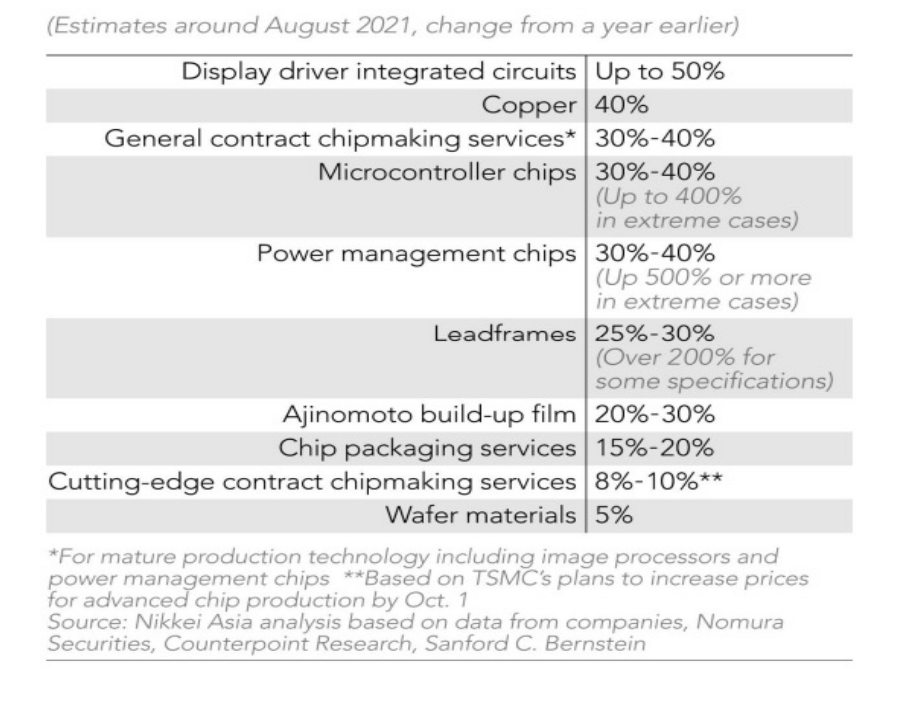
Prices are surging in chip supply chain (see image below)
STANDARD LOGIC
- The continuous acceleration of demand especially for automotive products has put more pressure on supply as we consider the outlook for 2022.
- Inventory levels in the channel are historically low and supply chain disruption is significantly up. Booking levels are up beyond historical highs with book to bill ratios hitting >1.5:1. The SOT353, SOT363 and QFN packages are severely constrained.
- Suppliers’ capacity utilization is very high and most back-end lines are fully booked through 2022. It is highly recommended to load POs to ensure suppliers can allocate both front-end and back-end capacity.
- Lead times have increased by an average of 75%, with some lead times now being quoted at 52 weeks.
- The supply base expects continued revenue growth driven by strong demand in all end markets. Prices are expected to continue surging in the semiconductor supply chain. With the continuation of robust demand, suppliers expect stable supply to be a challenge for the foreseeable future. The current front-end and back-end loading is very high with most capacity booked through 2022 and beyond.
- The demand for semiconductors is driven by confluence of acceleration on the digital transformation. Wireless/5G, IoT, and Automotive are the most important applications driving revenue over the year ahead.
- For 2022, the Global Semiconductor market is projected to grow by 10.1% to $606 billion.
- TSMC forecasts an increase in capital expenditure from $17B in 2020 to $28B in 2021.
- Suppliers are cautious of the impact caused by the Omicron variant, as the prospect of a fast-spreading variant has raised fears of a return to the sort of restrictions that shut down a swathe of industries in 2020. In the US, some auto plants were closed for two months last year. Even after automakers restarted operations, they have curtailed production schedules due to semiconductor chip shortages and other supply-chain constraints.
- Pricing trends for Logic continue to demonstrate increased pricing as book to bill ratios continue to grow as we enter 2022.
- Many suppliers are issuing Price Increase Notification letters.
- The entire semiconductor industry chain, including wafers, foundry and packaging are facing a shortage of raw materials or insufficient production capacity to meet the increased demand.
- A global shortage of wafer capacity will continue to cause price upticks and increased lead times well into 2022 and beyond.
DISCRETE
- Key assembly and test manufacturing plants in Southeast Asia such as Malaysia and Vietnam have seen a gradual easing of COVID-19 workforce restrictions. However, the strong market demand and overbooked wafer foundries and fabs mean the supply chain will continue to be stretched.
- Lead times for Diodes remain stable at an average of 40 - 50 weeks.
- BJT Transistors – lead times on average varying from 40 - 52 weeks.
- Low voltage MOSFET – lead times quoted on average from 40-52 weeks.
- Vishay lead times for MOSFET is stretching to 90 weeks.
- Infineon MOSFET are still under allocation with lead times ranging from 52 weeks to 80 weeks
- STM MOFET’s allocation situation remains with lead times on average 52 weeks plus.
- Nexperia remains on allocation across all parts, significant supply constraints on automotive MOSFET – lead times 52 weeks plus.
- Littelfuse fuses are typically at 45 weeks with an increasing trend whereby the MOSFET and IGBT products are quoted between 52 weeks and 62 weeks.
- The expansion of wafer foundries announced by some suppliers will only be complete by the second half of 2022.
- MCC’s new 4inch fab expansion was completed and focusing support on both MCC SOT and SOD package parts.
- STM’s front-end wafer expansion of their 8-inch manufacturing fab in Italy coming online in early 2022 will help in discrete and analog product delivery.
- Taiwan Semi (TSC) is estimated to have new capacity online for SMA/B/C products in the second of 2022 which is expected to drive improvements to lead times.
- Some suppliers have referenced a drop in laptop demand (also supported by Mercury Research). However, any free capacity is quickly consumed by other markets such as automotive and the renewable energy sectors.
- The smartphone market remains strong despite some manufacturers deferring consumption due to other gating components.
- China Manufacturing PMI is seeing some tapering, but global manufacturing PMI continues to rise with recovery from Europe and US.
- Suppliers are seeing book to bill ratios stabilizing; however, the overall level is still well above 1:1 and hovering around 1.2 to 1.5:1. Therefore, the 2022 supply chain will still be a significant challenge.
- Tier-1 manufacturers such as Infineon, onsemi, STM, Nexperia, and Vishay are implementing price increases for Q1 2022, from a minimum of 5% to double-digit percentages depending on the product type. Tier-2 suppliers such as MCC, LRC, Rectron, Panjit will provide flat pricing to minimal increases in Q1’22.
- We forecast that pricing will continue to rise for 2022 as all suppliers (including tier-2) continue to face increased costs for wafer, lead frame, power and logistics in addition to demand out pacing overall capacity.
OPTOELECTRONICS
- The supply situation continues to tighten for Opto couplers and InfraRed (IR) devices going into Q1’22, driven mainly by the upsurge in semiconductor demand across all market sectors. Lead times are stretching out to beyond 18 weeks for all opto couplers and IR devices. Customers are strongly advised to place longer term order coverage for critical and sole-source items through to 1H’22, to lock in capacity in order to prevent a supply interruption.
- More single-source, semi-customized LED manufacturers such as VISUAL COMMUNICATIONS COMPANY (VCC), PANASONIC, NICHIA & DIALIGHT, have been announcing EOL of their legacy products used in our on-going production without adequate advanced warning, LTB notice, and recommended replacement. Some Asia-based LED makers have also EOL’d products using Cree die, as Cree continues to de-commit deliveries. Customers are advised to work closely with us to qualify Jabil preferred suppliers to mitigate the supply risks.
- All suppliers are still reporting pent up demand for remote access products in computing, teleconferencing, access and mobile communications markets needed to support the work from home community.
- Growth area for invisible LED sectors: IR receiver for consumer products like set-top boxes and smart metering, couplers for DC power supply, data communication & cloud computing; optical sensors for printers, mobility, lifestyle wearables and automotive applications. Demand for UV LED is picking up as countries begin testing generic UV light sterilization in places with high human traffic such as shopping malls and subways.
- Capacity utilization rates for many leading LED manufacturers with Asian production bases (Thailand, Philippines, Malaysia, Taiwan, etc.) are still constrained, as these sites recover & are clearing order backlog from the pandemic shutdown. There is still capacity available if our preferred and suppliers are qualified to quickly ease constraints from Osram, Vishay and legacy suppliers like Broadcom and Japanese suppliers. Asia-based, leading automotive LED maker, Samsung Electronics is aggressively trying to penetrate European and US markets with better abd lower cost solutions than existing automotive suppliers like Osram, Panasonic and Nichia.
- As much visibility as possible should be given to the suppliers, especially for extended lead time products such as couplers, to avoid any potential supply issues.
- The Opto coupler market has been consolidating with low-end couplers (photo transistors) dominated by Asia-based suppliers such as Lite-on, Everlight and CTMicro. Couplers’ world #1, Broadcom, is still dominating the high-end, high-speed IC couplers market. Prominent China indigenous (top 3) LED suppliers MLS, Foshan Nationstar Inc. and Honglitronics continue to gain share amidst pandemic-driven shortages.
- Prices for all SMD LED from Asia-based suppliers are expected to stabilize in Q1’22. However, there will still be some price increases for opto couplers due to rising costs of raw material and substrates (driven by acute shortages in the semiconductor supply base globally), as well as freight charges. Higher prices are also partly the result of continued pent-up demand driven by the work-from-home market. Increased demand across all major market sectors notably in automotive and wireless communication sectors also contributed to the supply crunch.
- Customers are strongly advised to work with us to qualify Jabil preferred suppliers especially for sole source sockets to mitigate impact of the price increases. Longer term, pricing is being driven to what many believe is the bottom especially in the Consumer and Enterprise sectors and has bottomed out for commodity LEDs. In China, pressure driven from higher labor costs are affecting price levels on labor-intensive parts, display and housing LED or through-hole parts. As a result, our low-cost Asian suppliers have struggled to deliver additional cost savings to us. This is particularly prevalent on high-volume products such as smartphones and white goods.
VOLATILE MEMORY – DRAM
- DDR4: Constraints going into late quarter Q1’22.
- DDR3: Constraints going into late quarter Q1’22.
- Legacy (SDRAM, DDR1,2): Stable (Look to tier-2 suppliers for support).
- Industry analysts predict market stabilization in the first half of 2022 with limited bit growth but AI and 5G gradually rising. Uncertainty remains in the market and factories are still reporting a lack of capacity.
- Demand is exceeding production output in Q1. Expect Allocation from most suppliers.
- Raw Material shortages are contributing to extended lead times.
- Industry Analysts predict the proportion of IT spending moving to the Cloud will increase in the aftermath of the pandemic. Up to 14.2% by 2024.
- PC and Server demand is increasing, and smartphone demand is solid going into Q1’22.
- Suppliers remain cautious in capacity planning as the COVID-19 pandemic continues to affect stable demand visibility.
- DDR4: Some Increases.
- DDR3: Some Increases.
- Legacy (SDRAM, DDR1,2): Some Increases.
VOLATILE MEMORY – SRAM
- Asynchronous:
- Low Power: Stable.
- Fast SRAM: Stable.
- Slow SRAM: Stable.
- Synchronous:
- Quad Data Rate: Stable.
- Overall SRAM TAM is stable.
- A stable demand and supply base still exists in the marketplace today.
- Balanced market conditions are expected to continue throughout the 1H’22, expect some lead times to extend due to increased orders on suppliers.
- COVID-related issues still causing issues with suppliers.
- Asynchronous: Stable.
- Synchronous: Stable.
NON-VOLATILE MEMORY - NAND FLASH
Applies to NAND Flash derivative products such as Solid-State Drives, eMMC, Memory Cards and USB Drives.
- Planar NAND: Constraints.
- 3D NAND Flash: Constraints.
- NAND has returned to a seller’s market as strong adoption of Solid-State Drives in datacenter, PC and Next-Gen gaming consoles continue to drive Demand Bit growth into CY’22 (Bit rate growth in the range of high 20% - low 30%).
- Controller chips are allocated causing delays and allocation issues at major suppliers of SSDs, eMMC. Memory cards and USB devices.
- Q1’22 Industry bit supply growth expected to be less than bit demand growth due to muted CapEx investments in 2021.
- Uncertainties around COVID-19 still exist: Factories can be closed at any time if an outbreak occurs. Short-term demand has increased as production in China and Automotive markets are back online. Provide suppliers as much forecast visibility and hard orders as possible to ensure supply.
- Planar NAND: increases.
- 3D NAND Flash: increases.
NON-VOLATILE MEMORY - NOR FLASH
- Low-Mid Density NOR: Highly Constrained.
- High-Density NOR: Some Constraints.
- NOR Flash memory is anticipated to remain tight through Q1’22.
- Rising popularity of true wireless Bluetooth earbuds increased demand for NOR Flash memory and this is expected to continue into 2022. Coupled with 5G new product introductions, this will make supply tight.
- NOR Flash Foundry partners are also seeing increased demand from non-memory products that yield higher margins and this will limit capacity expansion plans for NOR Flash.
- COVID related issues continue to impact back-end facilities.
- Low-Mid Density NOR: Increases.
- High-Density NOR: Increases.
NON-VOLATILE MEMORY – EEPROM
- EEPROM: Stable.
- EEPROM is a mature memory technology.
- There is stable demand and a supply base that continues to support the marketplace today.
- Balanced market conditions are expected to continue into Q1’22.
- Make sure to monitor lead times and give ample forecast.
- EEPROM: Stable.
SENSOR
Highly Constrained
- MEMs and Sensor lead times remain constrained due to robust demand. Some SKUs at 52+ weeks of lead time.
- Upstream supply constraints for raw materials (wafers, metals, resins, lead frames, substrates, etc.) continue to affect the market.
- Foundries at full utilization. Demand has risen sharply, and supply has not been able to keep up resulting in drastically increased lead times and reduced flexibility.
- Recommended supply chain actions (dual sourcing, use of safety stocks, safety lead times and extended planning horizons) to mitigate risk of rising lead times and last-minute delivery delays.
- Minimum lead time needs to be adhered. Current market dynamics do not permit flexibility to support orders inside of lead time.
Growing Demand for Sensors
- Automotive electrification and IoT applications continue to fuel strong demand growth for Sensing technologies.
- The Healthcare segment is also driving up demand for sensing components used in COVID-19 Testing related applications.
- Proliferation of 5G will add to demand growth.
- New capacity from suppliers will go to innovative products with higher ROI and this may result in older sensing technologies going end of life.
- Supply of semiconductor-based sensors affected by ongoing worldwide shortage of semiconductor components.
Price Increases
- Constrained supply and rising lead times continue to put strong upward pressure on Sensor ASPs.
- Older technology products will be under pressure to compete with higher ROI products within the vendor’s product mix.
- Consecutive quarters of price increases issued by leading semiconductor manufacturers due to rising raw material cost driven by the sharp demand recovery. Many which have signaled additional price increases for Q1’22.
TIMING DEVICES
- Suppliers have extended their lead times due to higher book to bill ratio and strongly advise to plan accordingly as increasing demand on automotive, industrial and 5G network continues to be prevalent across the industry.
- Extended lead times due to wafer shortage issues at Foundry and lead frames as well as back-end capacity. Most suppliers have very high book/bill ratios.
- Based on the status of various foundries’ customer’s orders, we expect the current tight supply of wafer capacity to persist well into 2022. Foundries and subcons capacity is sold out as global demand exceeds supply.
- All products are currently in tight supply, with current lead times averaging 46 weeks to 52 weeks and some devices quoted at 78 weeks to 90 weeks. NCNR orders are being implemented to ensure the demand is real.
- The supply base expects continued revenue growth driven by strong demand in all end markets. Prices are expected to continue surging in the semiconductor supply chain. With the continuation of robust demand, suppliers expect stable supply to be a challenge for the foreseeable future. The current front-end and back-end loading is very high with most capacity booked through 2022 and beyond.
- For 2022, the global semiconductor market is projected to grow by 10.1% to $606B.
- TSMC increased capital expenditure from $17B in 2020 to $28B in 2021.
- Suppliers are cautious of the impact caused by the Omicron coronavirus variant, as the prospect of a fast-spreading variant has raised fears of a return to the sort of restrictions that shut down a swathe of industries in 2020. In the US, some auto plants were closed for two months last year. Even after automakers restarted operations, they have curtailed production schedules due to semiconductor chip shortages and other supply chain constraints.
- There are significant cost increases on wafers, lead frames, substrates, assembly & test as well as logistics. With limited supply of wafers, most suppliers are raising prices due to higher costs from foundry partners. Suppliers are passing through all of the cost increases to ensure supply continuity. Most suppliers continue to see strong book to bill ratios of > 1.5:1 and their backlog covering 2022 and into 2023.
- ADI/Maxim, Microchip, NXP, Renesas, Skyworks and ST issued notifications on price increases.

Back to Top