




By clicking the “I Accept” button, or by accessing, participating, or submitting any information, or using the Jabil Global Intelligence Portal or any of its associated software, you warrant that you are duly authorized to accept the Global Intelligence Portal Terms and Conditions on behalf of your Company, intending to be legally bound hereby, and your company shall be bound by the terms and provisions of the Global Intelligence Portal Terms and Conditions, accessible under the following link Portal T&Cs.
Jabil's Global Commodity Intelligence Archive
Q1 2022
Jabil's Global Commodity Intelligence Archive
Q1 2022
HIGH END SEMICONDUCTOR COMMODITIES
MCU / MCP / Chipset / ASIC/ Prog Logic
- Supply continues to remain very tight due to continued strong demand. There is some stabilization in supply for automotive MCUs and continued priorization for medical applications. Most other verticals remain in a critical position. It’s difficult for manufacturers to manage the mix and we see continued bottlenecks in specific product families, due to limitation in capacity expansion at the foundry with wafer output not meeting demand. We expect the situation for those products to be constrained through all of 2022.
- All nodes in the supply chain remain constrained.
- Front-end: the majority of older generation fabs (8” 130nm, 180nm, 12” 40nm, 65nm, 90nm) continue to be severely constrained with many product families remaining in allocation. Most manufacturers have implemented NCNR orders throughout 2022.
- Back-end: remains overall critical due to raw material shortages – lead frames and substrates. We expect to continue to see short notice decommitments due to OSATs running at full capacity. Most manufacturers are adding back-end capacity internally in the coming quarters to support additional business levels, but can’t keep up with the overall demand.
- MCU: majority of the products are on allocation.
- STMicroelectronics: lead time is 65 weeks for all MCU products, NCNR is implemented as of November. Lead time is a reference, all MCU products are on allocation, STM32F, STM8S have severe supply shortage.
- Microchip: lead time is 60 weeks for all MCU’s with products within the PSP program being on NCNR.
- Supply for parts in the PSP program are relatively stable, parts not in PSP are being pushed out.
- NXP: lead time remains at 52w for all MCU and MPU’s.
- MK/Kinetis (Global Foundries 90TFS process) is only expected to improve by Q3’22.
- I.MX25x remains very constraint through 2022 due to capacity limitations.
- TI: is requesting demand visibility of 78 weeks in order to manage the longer term backlog. Wireless products like CC1xx/CC25xx are very tight.
- Infineon/Cypress: remains 52 weeks for MCU’s, somewhat better visibility on allocation for wireless MCU’s.
- Renesas: lead times remain at 52 weeks; key OEM programs will be under NCNR for 2022 through the DSP program.
- Silicon Labs: EFR32/EFM32 product family remains very constrained. Recommendation is to move to the Series 2 devices – EFx32xx2.
- SoC business: Severe shortages on older nodes, 28nm and above. Ethernet products are problematic, older gen Wi-Fi solutions remain very constrained.
- Marvell: lead times are >52 weeks, all products are on NCNR.
- Broadcom: lead times are >60 weeks, all products are on NCNR.
- Qualcomm: lead times further extended, most SoC products are on allocation.
- Intel Ethernet product: lead times extend to >52 weeks. Intel is accelerating EOL for older generation devices.
- Microchip: lead times are >60 weeks with limited flexibility for LAN/USB/VSC products.
- FPGA: supply is severely constrained as there is limited capacity in older gen nodes – 40nm/55nm/180nm.
- Xilinx: Spartan-6 devices are on hard allocation. There is not sufficient supply to support all OEMs and Xilinx is recommending to migrate to Spartan-7 devices.
- Xilinx is asking >1y visibility for the other devices.
- Intel (Altera product families): all devices are under allocation except Stratix 10 and Agilex.
- Max-V (180nm), Max-10 (55nm) are severely impacted by the lack of supply from foundry, allocation is done based on OEM. Supply for most other FPGA families is very tight.
- Enpirion DC-DC module portfolio will go in LTB by Q1’22. It’s highly recommended to review alternate options from TI, MPS or ADI as Intel doesn’t have enough capacity to support all LTS’s by Q1’23.
- Microchip: supply is tight with lead times in the 60-week range.
- Lattice: tight supply with lead times between 35 and 52 weeks. Lattice is offering a number of focus parts for product conversion from Intel MAX-V, Max-10 and Xilinx Spartan-6.
- Xilinx: Spartan-6 devices are on hard allocation. There is not sufficient supply to support all OEMs and Xilinx is recommending to migrate to Spartan-7 devices.
- CPUs: Intel supply is tight with prioritization on Ice Lake, which limits output on previous gen CPUs.
- RF semiconductors: lead times remain high at 20-24 weeks.
- We see the market is trending towards smaller M&A deals.
- AMD is expecting to close the Xilinx deal by the end of 2021 after making progress with the Chinese regulation bodies.
- Nvidia’s acquisition of ARM is becoming unlikely to go through due to increased regulatory challenges.
- Most manufacturers continue to invest heavily in internal capacity. Infineon, STM, Intel and TI are significantly investing in internal foundry capacity, NXP & Microchip are investing mainly in back-end.
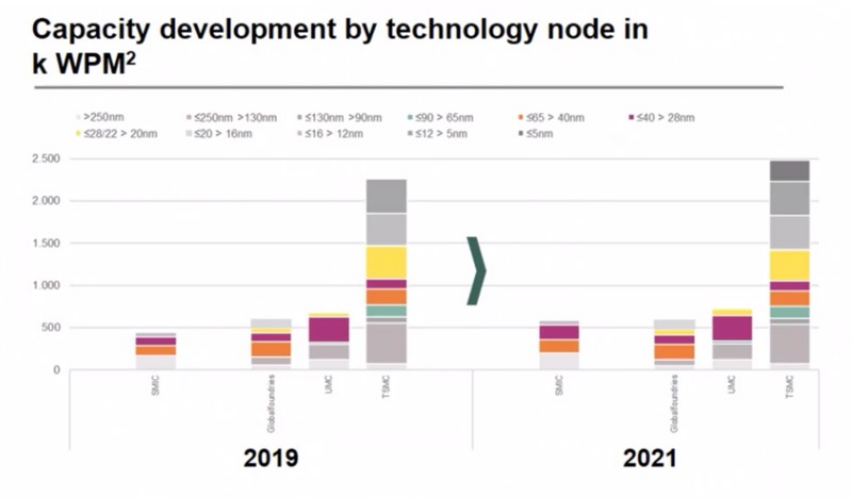
- Pure play foundry leaders like TSMC, UMC, GF are investing significant amounts, predominantly in state-of-the technologies <28nm. This is not resolving bottlenecks for mature devices and standard products like WIFI-4, WIFI-5, ethernet products, analog, std MCUs. This is creating an unbalanced supply situation.
- Due to the constrained market conditions and increased raw material costs (wafer), we continue to see price adjustments ranging from 10% up to 40%, across almost all manufacturers. We expect this to expand going into 2022 for bottleneck products. Examples of price increases that occurred in Q4’21:
- Intel: 20% on FPGA, 25%-40% on Ethernet controllers, 7% for CPU
- Xilinx: 20%
- Lattice: 15%
- Marvell: 23%
- NXP: 10% on the majority of the portfolio
- Silicon Labs: upto 29% for MCU’s, 39% for Sensors
- Skyworks: 15-30% for the former Silabs timing products
- Renesas, STM & TI also anounced increases
- Suppliers continue to defocus legacy devices with price increases and accelerated EOL.

Back to Top